Friday, August 21, 2020

Timelines of Humans in Hinduism

 Timelines of Humans in Hinduism 

Source: Twitter handle - https://twitter.com/RapperPandit/status/1270202356219568128


Image

1. How &When did Humans Originate? 1. What happens on 31Dec, dt We All celebrate NewYear? 2.Why Scientifically we Call Earth "Mother" 3.What Came First Egg or Chicken 4. How Old is the Universe 5.CosmicTime Scales ScientificallyExplained
Image

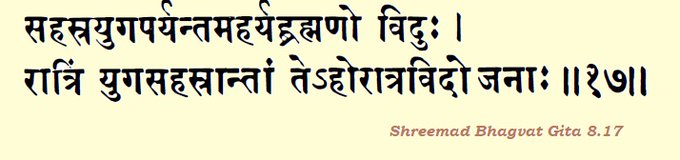
Let us absorb below Points First: 1. Celestial Config is NOT Unique, Repeats in 25920Yr (360Deg*72Yrs/Deg) 2. We are Not a 5000 Yr Old Civilization, We are Infinitely Old , Time is Cyclical 3. Ignoring Concepts of MahaYuga, Kalpa etc=Giving up Smd. Bhagvat Gita & Veda

There are Two Things Scientists haven't Figured Out. -How Old Human Race is -How Actually Species Came into being.

Image

A Very Important Question- In 1000s of Years of History, Did You come across any incident record of a Monkey getting upgraded to Human, as per Darwin's Theory of Evolution? Shockingly the answer is No! Let's delve in the Fascinating facts.
Image

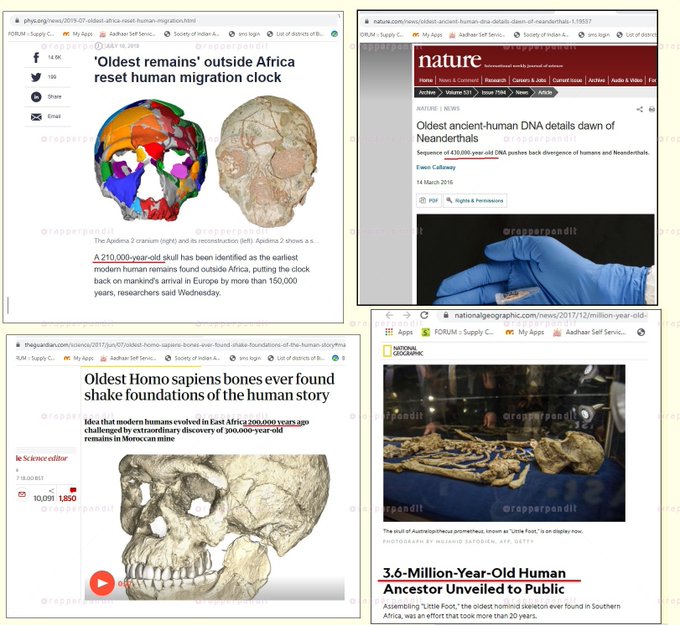
Western Creation Date is 23.Feb.4004BC -That's Why Vedic era is fixed at most 1500BC -History, Education&Science conform to it. -West Initially concluded Humans have been around for Few Thousand Years -But New Findings:: Humans 2.1 Lac Yrs Old & Later 3.5 Crore Yrs Old
Image


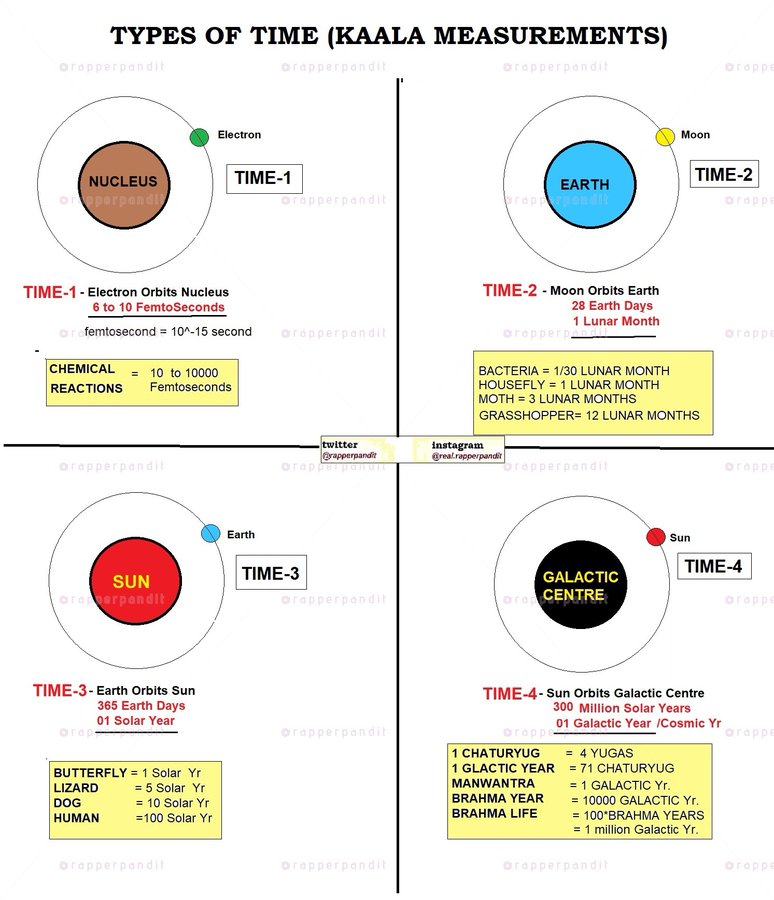
काल is All Relative Time Experience. Only the Supreme Godhead is Above Time or MahaaKaala. From Atom to insects to birds to humans to divine all have relative Time Experiences. What a Butterfly Experiences in 1 Yr is like what we experience 100 Yrs Please refer to the chart above.
Image

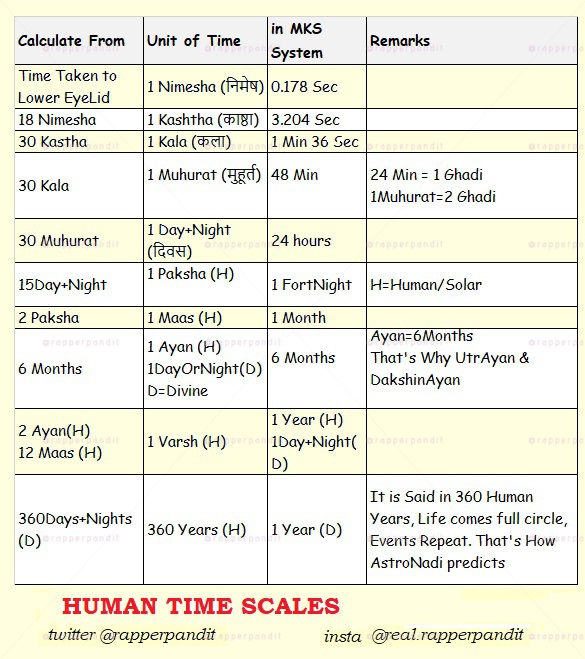
Just Look at the Indian TIME scales from Small to Gigantic. These 24hrs, 7 weeks, 12months, 30 days/month Concepts are Ours West never had an Orginal Calender. These Time Scales are up to what Humans can experience
Image

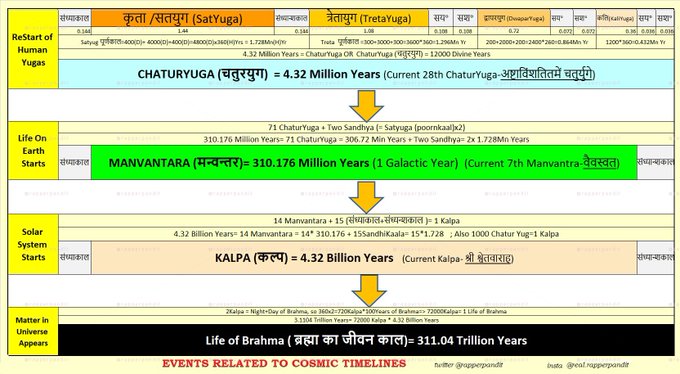
Gigantic Scales from Human Till Brahma. There are Time Scales above Brahma as well, Not Discussed Here. (0.178 Second) Nimesha->Kastha->Kala->Muhurat->Divas->Paksh->Maas->Ayan Varsh->Yuga->ChaturYuga->Manvantra->Kalpa->Brahma Divas->Brahma Kaal (311.04Trillion years)


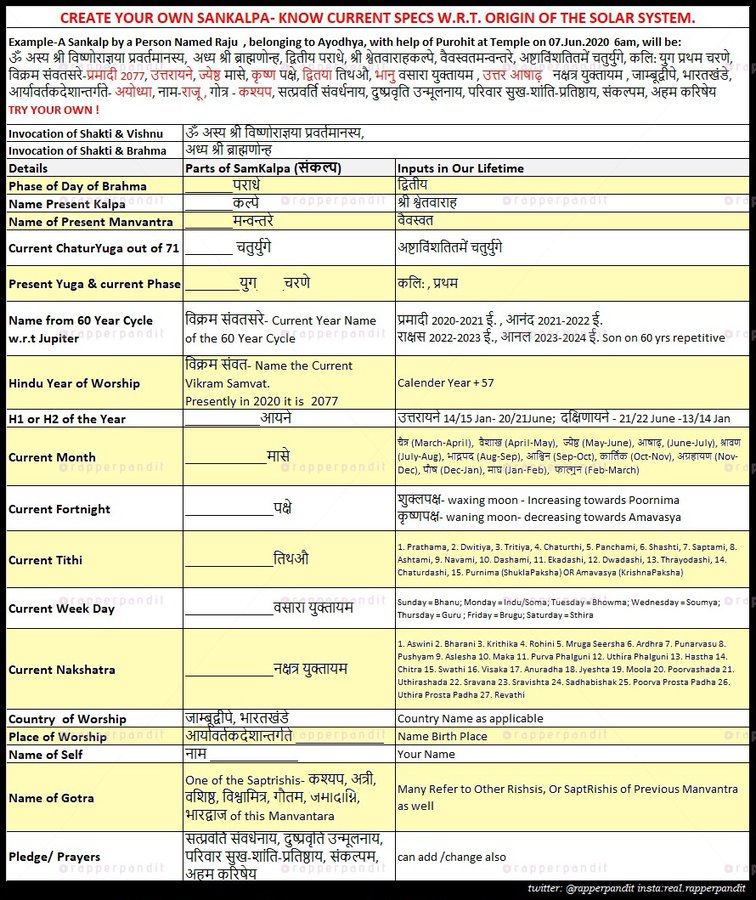
Human Time is the Time of Solar System- ONLY Whenever you take Sankalp in Any Temple- The Purohit will Mark your Attendance from the Beginning of The Solar System. Please Read the Below Chart Can you Now Make Your Own Sankalpa? If Yes !, Please Do Post your Sankalpa here!
Image

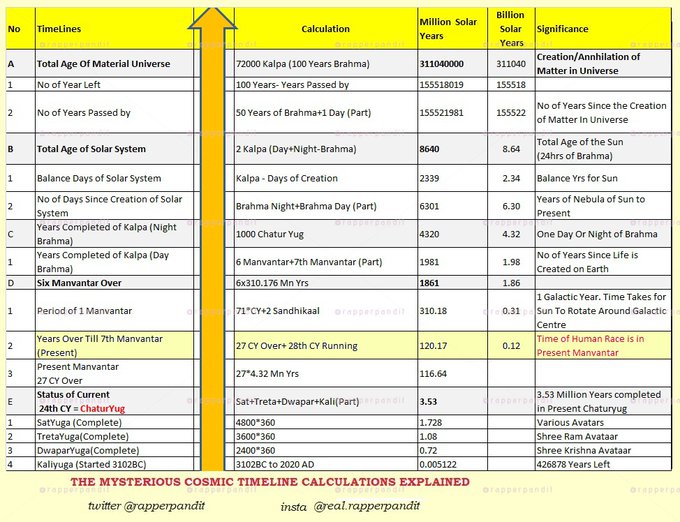
When we say उसका काया कल्प हो गया, Kalpa means Complete Transition. OUR SOLAR SYSTEM- -In 1st Kapa (Night of Brahma) 4.32 Bn Yrs- Annhilation of Matter into Force & Reasembly of Forces into Matter is Redied. -In 2nd Kapa (Day of Brahma) 4.32 Bn Yrs- Play of Matter & Life
Image

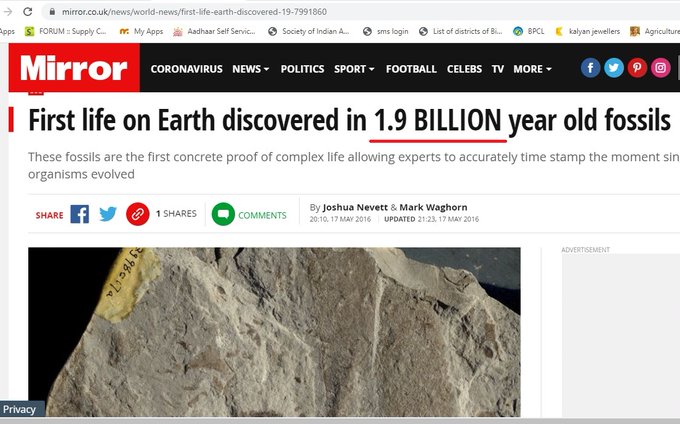
Did You note in Prev Chart, as per Sanatan Dharm: -Earliest Microbial Life Appeared 1.9Billion Yrs Ago- Same as Age of Present Kalpa. -#Pic-Scientific Finding Before the Human Race, all the other Creation&Life was ready 120 Million Yr Ago The First Human Race Appeared
Image


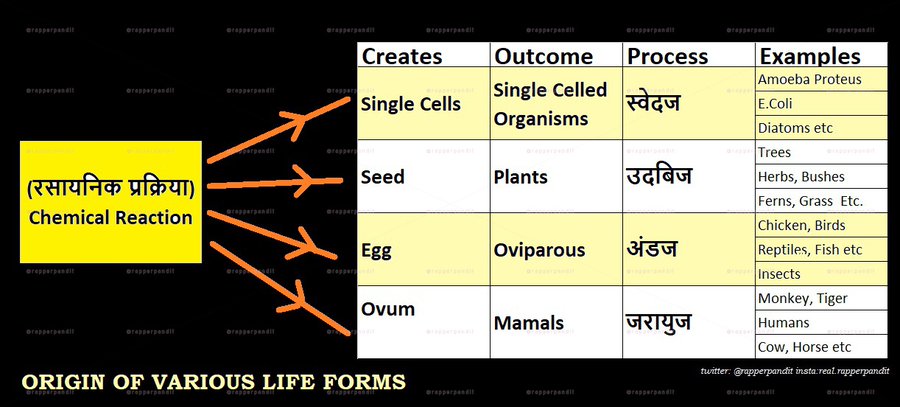
Did Egg Came First or Chicken? -How Lice Appears in Head? -How Spiders & Inspects Come Alive in a House was Fully Closed? -1st Batch of All Organisms Created thru Chemical Reaction? -There are 4 Processes thru which Organisms are created-स्वेदज, उदबिज, अंडज, जरायुज
Image

What Womb is to Mother, Soil is to Earth उदबिज = Life from Seed अंडज = Life from Egg जरायुज= Mammals Including Humans All Come From Soil Chem. Reactions gave rise to the first batch of स्वेदज, उदबिज अंडज जरायुज Organisms Doesn’t Mean Cell Became Monkey became Human
Image

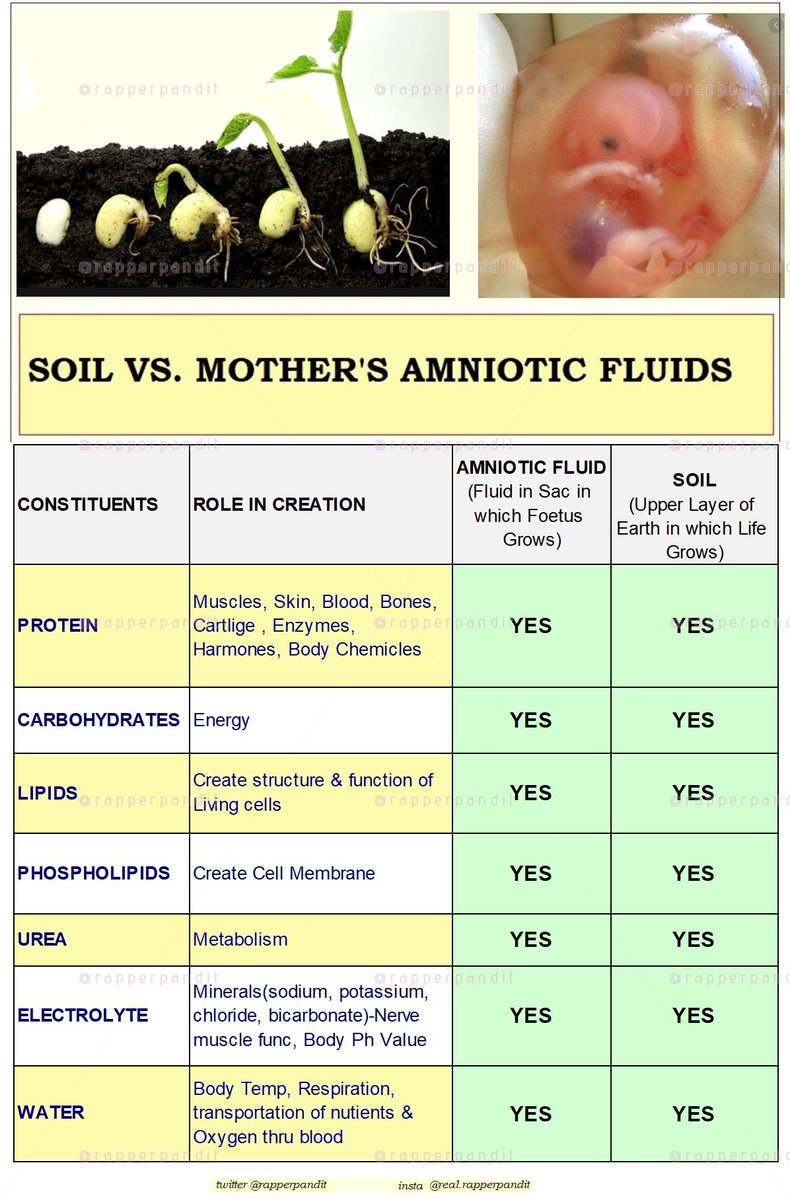
SOIL is to EARTH What WOMB is to MOTHER! -Fluid in Amniotic Sac of WOMB: The Foetus in Womb grows due to Fluid which is Water& Electrolytes; by the 12-14th week also contains Proteins, Carbohydrates, Lipids & Phospholipids & Urea -SOIL Contains All of These (Like MOTHER)
Image


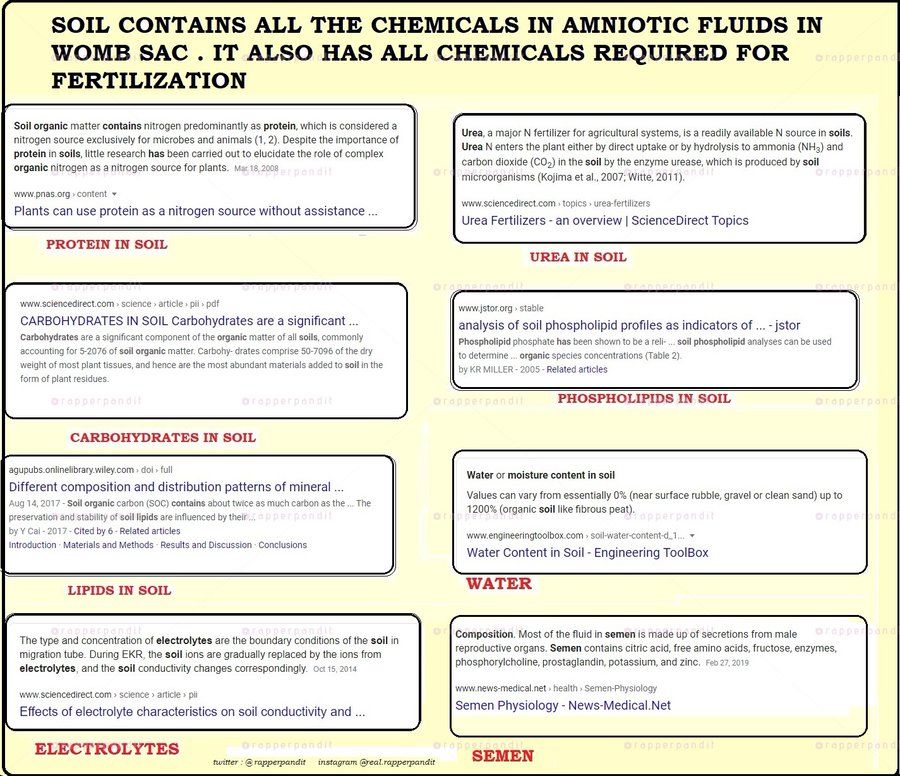
शरीर मिट्टी है, मिट्टी में मिल जाएगा -Egg (Ovum): created in Soil (Womb) by ChemReaction thru Brahma's "Mind Power" -Soil has All Chemicls of Sperm/Semen: Citric/Amn Acid, Fructs,Enzym,Phsphrylcholine,Prostaglandin,Ka,Zn -Fertilization at many places for मानस पुत्र/पुत्री
Image

Now Ask yourself, If you were the Creator, What Would be your Choice for the First Human Being Born in a Wild Nature? 1. A young Defenseless & Dependant 1 Day Infant 2. A Strong & Intelligent Full Grown Adult who could Nourish himself/herself and save from Wild Animals

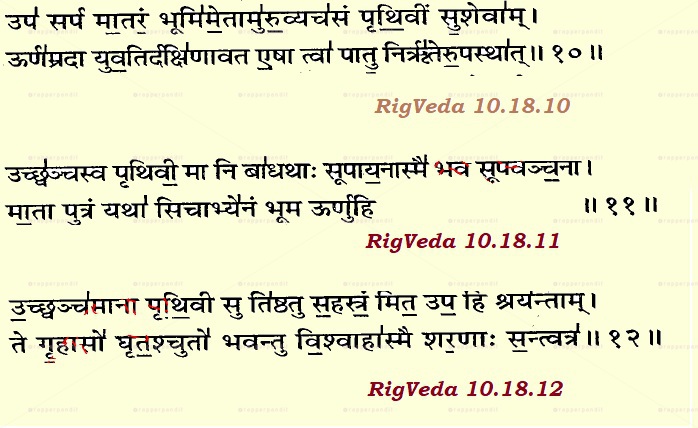
1st Batch of Humans Gestated in Soil (just like in Womb) for Not Months but Years and Erupted Not as babies but as an Adult Men/Women -Before Humans, All जरायज (Mammals) on Earth Were Born Like that only. -Rig-Veda Clearly Describe the Motherly (Womb Like) aspects of Earth
Image

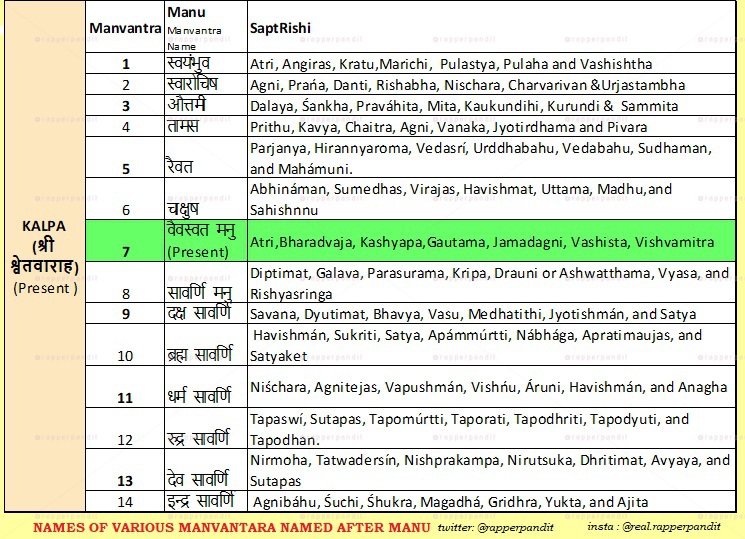
Each Manvantra Refers to a Human Race, Comprising of a Manu, Different Set of 7 Rishis-SaptRishis, PrajaPatis, Indra and other Gods, Praja and a King as PrajaPati Each Kalpa has 14 ManVantras.
Name of Current Manu: वैवस्वत -Name of Current Kalpa: श्री श्वेतवाराह
Image

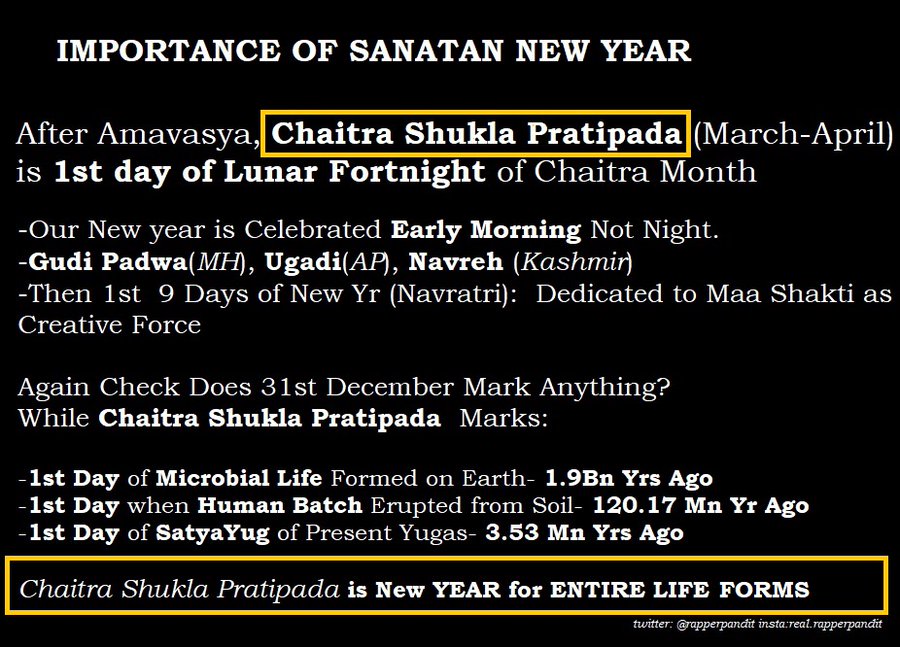
1st Day of Microbial Life on Earth- 1.9Bn Yrs Ago 1st Day when Human Batch Erupted from Soil- 120.17Mn Yr Ago 1st Day of SatyaYug of Present Yugas- 3.53Mn Yrs Ago All the Above on ChaitraShuklaPratipada: Sanatan New Yr is for Humanity But What Happened on 31st Dec- NOTHING!
Image


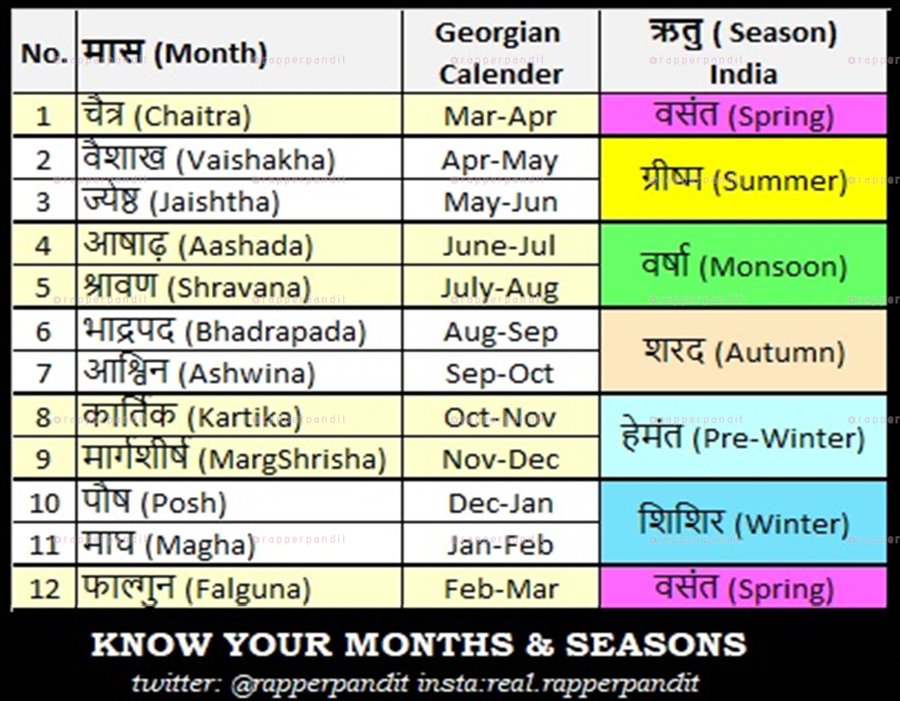
Next Time Remember to Celebrate New Year On ChaitraShuklaPratipada. (1st Day of Navratra) -This Year it was on 24.March.2020 -Next Year it will be on 12.April.2020 Please, refer below Chart to Know Sanatan Months, Ritu (Seasons) wrt to Georgian Calender.
Image

Known is Infinitesimal of UNKNOWN -Don’t Believe, Just Seek -Ask the Reason & Logic behind everything & Truth will Just Appear! -Sanatanis have always been Seekers/Never, Believers - From Smd. Bhagavad Gita to Sutras - They Contain Doubts, Questions, Discussions & Answers.

Refrences - Nature Science Journal, National Geographic, TheGaurdian, Physorg, Science Direct
Indian References: RigVeda, विशुद्धManusmriti -Dr.SurendraKumar&RajivShastri, Acharya AgniVrat, True History :Calenders- Dr. CK Raju ji & ji

Monday, August 17, 2020

Caste discrimination in Mahabharata

 Caste discrimination in Mahabharata

Source: https://twitter.com/VedicWisdom1/status/1295361527612977153?s=20

These are two famous Myths here which will be debunked. 1. Eklavya was discriminated against because of his caste. Wrong there is no Caste issue in this story.

Drona specifically said he needed students who possess good qualities. He did not take students who possessed bad qualities


Image


Now let's see Eklavya, he was actually covered with filth and was very dirty. Those who cannot maintain even basic hygiene can they responsibly use weapons they possessed?


Image

शौच (Hygeine) was the first thing taught to a child at that time most basic, Lacking that meant he was not worthy of learning. He did learn in the forest and he misused that too by shooting arrows in the mouth of an innocent dog. As he was not worthy Drona asked for his thumb.

Also, Same Eklavya later attacked Dwarka and was defeated by Balrama


2. Karna also was not discriminated because of his Caste, utas used to study Vedas, Smritis, Puranas etc at that time, they were not discriminated against. Mahabharat Shanti Parva states-


Image


Sunday, September 1, 2019

Thriputharaatu

On twitter by
https://twitter.com/iamanjooti/status/1167813511663239169

Some pics from todays Thriputharaatu.Parvathi Devi at Chengannur Mahadeva temple is a menstruating goddess.Her holy bath on the fourth day is celebrated as Thriputharattu.A chief feature is Chamayathaalapoli where young girls dressed with ornaments welcome her.


Image
Image

Image


Image


After her holy bath ,Devi is received by devotees mainly women back to the temple in procession

Image

Image

Image

Image

At the temple,Devi Parvathi is welcomed by Lord Mahadeva. This is called Shiva Parvathi Sangama,another highlight of Thriputharattu

Image

Image

Women across all ages welcome her and accompany her in her Arattu.They are referred to as amma's friends or Thozhimaar. Thriputharattu where menstruation of Devi Parvathi is celebrated is a festival of womanhood

Image

Image

Image

Thank you - Anjali.

Friday, February 9, 2018

Hindu Astonomy

Source : @templescience on FaceBook

🔥🔥  This Ancient Vedic Text (Srimad-Bhagavatam) gives an Accurate Map of the Planetary Orbits known to Modern Astronomy  🔥🔥

Today we take for granted that the earth is a sphere, but the early Greeks tended to think it was flat.
For example, in the fifth century B.C. the philosopher Thales thought of the earth as a disk floating on water like a log.
1. About a century later, Anaxagoras taught that it is flat like a lid and stays suspended in air.
2. A few decades later, the famous atomist Democritus argued that the earth is shaped like a tambourine and is tilted downwards toward the south.
3. Although some say that Pythagoras, in the sixth century B.C., was the first to view the earth as a sphere, this idea did not catch on quickly among the Greeks, and the first attempt to measure the earth’s diameter is generally attributed to Eratosthenes in the second century B.C.
💥
Scholars widely believe that prior to the philosophical and scientific achievements of the Greeks, people in ancient civilized societies regarded the earth as a flat disk.

So to find that the Bhagavata Purana of India appears to describe a sphere earth comes as enough incredulity.
The Bhagavata Purana, or Srimad-Bhagavatam, is dated by scholars to A.D. 500-1000, although it is acknowledged to contain much older material and its traditional date is the beginning of the third millennium B.C.
💥
In the Bhagavatam, Bhumandala - the “Earth Mandala” - is a sphere 500 million yojanas in diameter.
The Yojana is a unit of distance about 8 miles long, and so the diameter of Bhumandala is about 4 billion miles.

Bhumandala is marked by circular features designated as islands and oceans. These features are listed in Table 1, along with their dimensions, as given in the Bhagavatam.
🌅
Let's check ,
Bhagavata Purana, composed around 1800 BCE (according to western historians) describes in detail, Stars, planets in our solar system, Sun, their dimensions, distances between them, climatic and karmic effects of their movement.

"sa eṣa bhagavān ādi-puruṣa eva sākṣān nārāyaṇo lokānāṁ svastaya ātmānaṁ trayīmayaṁ karma-viśuddhi-nimittaṁ kavibhir api ca vedena vijijñāsyamāno dvādaśadhā vibhajya ṣaṭsu vasantādiṣv ṛtuṣu yathopa-joṣam ṛtu-guṇān vidadhāti"

Translation :
Original cause of the cosmic manifestation is the Supreme Personality of Godhead, Nārāyaṇa.
When great saintly persons, fully aware of the Vedic knowledge, offered prayers to the Supreme Person, He descended to this material world in the form of the sun to benefit all the planets and purify fruitive activities.
He divided Himself into twelve parts and created seasonal forms, beginning with spring. In this way He created the seasonal qualities, such as heat, cold and so on.
🔥
Srimad Bhagavatam, Canto 5, Chapter 22 describes our solar system in detail.

"yathā kulāla-cakreṇa bhramatā saha bhramatāṁ tad-āśrayāṇāṁ pipīlikādīnāṁ gatir anyaiva pradeśāntareṣv apy upalabhyamānatvād evaṁ nakṣatra-rāśibhir upalakṣitena kāla-cakreṇa dhruvaṁ meruṁ ca pradakṣiṇena paridhāvatā saha paridhāvamānānāṁ tad-āśrayāṇāṁ sūryādīnāṁ grahāṇāṁ gatir anyaiva nakṣatrāntare rāśy-antare copalabhyamānatvāt"

Translation :
Śrī Śukadeva Gosvāmī clearly answered:
When a potter’s wheel is moving and small ants located on that big wheel are moving with it, one can see that their motion is different from that of the wheel because they appear sometimes on one part of the wheel and sometimes on another.
Similarly, the signs and constellations, with Sumeru and Dhruvaloka on their right, move with the wheel of time, and the antlike sun and other planets move with them.
The sun and planets, however, are seen in different signs and constellations at different times.
This indicates that their motion is different from that of the zodiac and the wheel of time itself.
🚩🚩
The time that the passage of the sun takes moving through both the spheres above and below, speeding slow, fast or moderate, is in the descriptions of the scholars discussed as a samvatsara [a solar year],
a parivatsara [one twelfth of a revolution of Jupiter],
an idâvatsara [a day of the gods consisting of 360 solar days]
an anuvatsara [a lunar year comprising twelve lunations] and
a vatsara [a year to the ecliptic in terms of the 27 lunar mansions or nakshatras]
👩‍💼👩‍💼
"evaṁ candramā arka-gabhastibhya upariṣṭāl lakṣa-yojanata upalabhyamāno ’rkasya saṁvatsara-bhuktiṁ pakṣābhyāṁ māsa-bhuktiṁ sapādarkṣābhyāṁ dinenaiva pakṣa-bhuktim agracārī drutatara-gamano bhuṅkte.

Translation : Sun lit Moon, who is placed a hundred thousand yojanas [astronomy: ± 385.000 km] above [the earth] and is moving much faster [than the sun], is so the passage of one year of the sun covered by the passage of two fortnights, is in two and a quarter of a day one solar month [or one twelfth of the sky] passed and is in only one day [the portion of] a fortnight of solar days passed.

(Modern astronauts estimated distance between Earth and Moon to be 384,400 km)
🌏🌏🌏
tata upariṣṭād dvi-lakṣa-yojanato nakṣatrāṇi meruṁ dakṣiṇenaiva kālāyana īśvara-yojitāni sahābhijitāṣṭā-viṁśatiḥ.

Translation :
[More than] two hundred thousand yojanas behind [the moon], leaving Meru to the right are there, together with the many stars by the Controller attached to the wheel of time, the twenty-eight stars headed by Abhijit (Vega).
🌠
"tata upariṣṭād uśanā dvi-lakṣa-yojanata upalabhyate purataḥ paścāt sahaiva vārkasya śaighrya-māndya-sāmyābhir gatibhir arkavac carati lokānāṁ nityadānukūla eva prāyeṇa varṣayaṁś cāreṇānumīyate sa vṛṣṭi-viṣṭambha-grahopaśamanaḥ"

Translation :
At a distance of two hundred thousand yojanas there about [about the star center or the sun; astronomy: at a distance of 107 million km] there is Us’anâ [Venus], the planet that can be seen going in front, behind and rotating along with the sun just as fast, slow or with a moderate speed. It is of all the planets the one considered to exert as good as always a favorable influence in the form of rainfall, it by its movements neutralizes the influence of planets that obstruct rainfall.
🌅
"uśanasā budho vyākhyātas tata upariṣṭād dvi-lakṣa-yojanato budhaḥ soma-suta upalabhyamānaḥ prāyeṇa śubha-kṛd yadārkād vyatiricyeta tadātivātābhra-prāyānāvṛṣṭy-ādi-bhayam āśaṁsate"

Translation :
Another two hundred thousand yoyana’s behind Venus [astronomy: 57.9 million miles from the sun], so is explained, is there situated Mercury, the son of the moon; he is as good as always working auspiciously, but at the time he stands apart from the sun is there almost always an increase of fearful conditions like draughts, a closed sky, and stormy conditions.
🌅
"ata ūrdhvam aṅgārako ’pi yojana-lakṣa-dvitaya upalabhyamānas tribhis tribhiḥ pakṣair ekaikaśo rāśīn dvādaśānubhuṅkte yadi na vakreṇābhivartate prāyeṇāśubha-graho ’gha-śaṁsaḥ"

Translation :
Two hundred thousands yojanas outside of our orbit there is also Mars [astronomy: at about 228 million km from the sun]; in three by three fortnights does he, if he doesn’t make a curve, one after another pass through the twelve signs and in his approach he is as good as always an unfavorable planet giving trouble.
💥
"tata upariṣṭād dvi-lakṣa-yojanāntara-gatā bhagavān bṛhaspatir ekaikasmin rāśau parivatsaraṁ parivatsaraṁ carati yadi na vakraḥ syāt prāyeṇānukūlo brāhmaṇa-kulasya"

Translation :
Two hundred thousand yojanas outside of Mars [astronomy: 778.3 million km from the sun] is there the most powerful planet Jupiter who, if he doesn’t run a curve, takes a year [parivatsara] to one after another move through one sign; to the brahmins in the universe he almost always turns out to be very favorable.
💥
"tata upariṣṭād yojana-lakṣa-dvayāt pratīyamānaḥ śanaiścara ekaikasmin rāśau triṁśan māsān vilambamānaḥ sarvān evānuparyeti tāvadbhir anuvatsaraiḥ prāyeṇa hi sarveṣām aśāntikaraḥ"

Translation :
Two hundred thousand yojanas behind him is situated Saturn [astronomy: 1.43 billion km from the sun], who takes a period of thirty months to travel through each single sign and for sure is as slow as taking an equal number of years [anuvatsara’s] to pass through all of them; he indeed means almost always a lot of trouble to all.
🔥🔥
"tata uttarasmād ṛṣaya ekādaśa-lakṣa-yojanāntara upalabhyante ya eva lokānāṁ śam anubhāvayanto bhagavato viṣṇor yat paramaṁ padaṁ pradakṣiṇaṁ prakramanti"

Translation :
1.1 million yojanas beyond that one are situated all the great sages who verily always think of the good fortune of the inhabitants of all the worlds; leaving it to the right do they circumambulate the transcendental abode of the Supreme Lord Vishnu [the center of the stars]
🌠🌏🌠
At first glance, the cosmology of the Srimad-Bhagavatam might seem like a wild fantasy. Here are four ways to make sense of it all.

The inquisitive human mind naturally yearns to understand the universe and man’s place within it. Today scientists rely on powerful telescopes and sophisticated computers to formulate cosmological theories. In former times, people got their information from traditional books of wisdom.

Followers of the Vedic culture, for example, learned about the cosmos from scriptures like the Srimad-Bhagavatam, or Bhagavata Purana.

But the Bhagavatam’s descriptions of the universe often baffle modern students of Vedic literature. Here Bhaktivedanta Institute scientist Dr. Richard Thompson suggests a framework for understanding the Bhagavatam’s descriptions that squares with our experience and modern discoveries.
💥🔥💥
The Srimad-Bhagavatam presents an earth-centered conception of the cosmos. At first glance the cosmology seems foreign, but a closer look reveals that not only does the cosmology of the Bhagavatam describe the world of our experience, but it also presents a much larger and more complete cosmological picture. I’ll explain.
✍️✍️✍️✍️✍️✍️
For verification : http://www.bhagavata.org/canto5/c5-contents.html

Tuesday, August 15, 2017

The Britishers took away the control of India from the Marathas and not from the Mughals

The Britishers took away the control of India from the Marathas and not from the Mughals


 Courtsy :Pulkit Mishra-  @pulkitmishra007 

Can you name the war that the Mughals fought against the British? You cannot because there was none.

When Robert Clive defeated the Nawab of Bengal in the Battle of Plassey to put the foundation stone of the British Empire,

the Mughal Emperor Alamgir II, was a 58 year old puppet, put to the throne by the Mighty Marathas and kingmaker Imad-ul-Mulk.

Yes, Marathas and not Mughals were the dominant power, when the British entered India.

In fact, Marathas ruled over an Empire larger than that of Akbar, dominating India for over 75 years.


There was a famous saying (Kahawat) for the Mughal Emperor Shah Alam II who reigned soon after Alamgir II 

"Sultanat-e-Shah Alam, Az Dilli ta Palam", meaning, 'The kingdom of Shah Alam is from Delhi to Palam', Palam being a suburb of Delhi. 

The Mughal kings that came after Shah Alam were mere pensioners under the British rule and weren’t the dominating force they are pictured to be

The British had to face the Mighty Marathas and not the Mughals in the first major war for the control of the Indian Sub-continent 

The Anglo Maratha War in 1775–82, which ended up in the Surrender of the British Troops.

It took conceit, treachery, manipulation & 44 long years of war against the Marathas for Brits to finally consolidate the British Empire.

https://en.wikipedia.org/wiki/Maratha_Empire


Martial Arts and Zen buddhism were founded in China by an Indian

Martial Arts and Zen buddhism were founded in China by an Indian

 Courtsy :Pulkit Mishra-  @pulkitmishra007 

Bodhidharma, a Pallava prince from Kanchipuram in Southern India went on to become the first patriarch of the Chan Buddhism in China.

He established what we now know as the Shaolin temple and Kung-Fu.


 We have bad slavery blood, hence tend to believe more in non-Indians. Here is the proof

https://www.youtube.com/watch?v=GQiK8m_Z8fo


Wednesday, August 9, 2017

Best Devanagari Typefaces


Sign up

Dharmāesthetics🚩🚩

Absolute Hindu Monarchy. No compromise.

Apr 20

Best Devanagari Typefaces

Find few beautiful fonts among the slim pickings of this Brahmi based gorgeous script

Anatomy of the Devanagari Font

If one script were to represent the great Indian intellectual tradition, it would without doubt be the Devanagari Script (Devanāgarī or देवनागरी). Used for over 120 languages including the major ones such as Sanskrit, Hindi, Marathi, Nepali among others this is a very beautiful script. Even though it’s the native script for more than 500 million people, selection for typefaces are pretty bad. However, recent explosion of mobile usage across the globe might help curb these issues.

Here, I present to you a list of high quality Devanagari typefaces which I think are worth of use and praise. Hopefully, this encourages people to make many more.

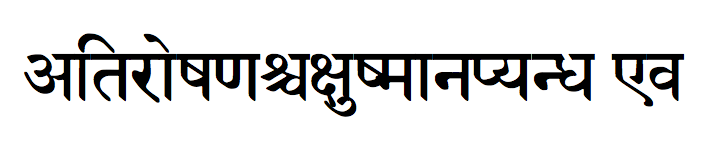
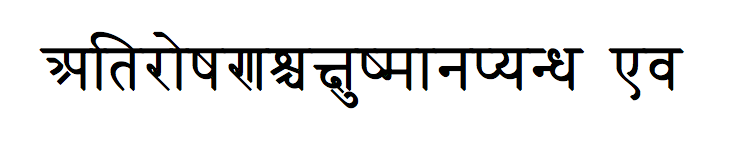
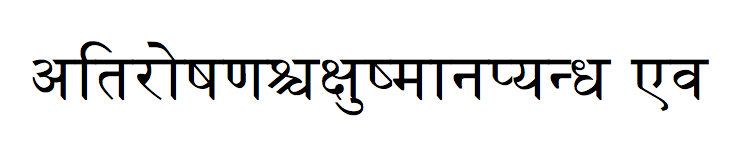
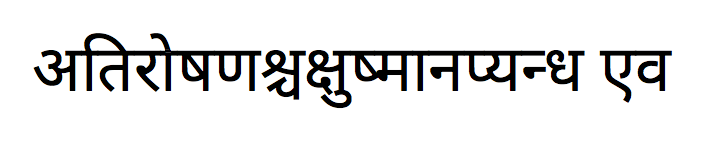
Test text: अतिरोषणश्चक्षुष्मानप्यन्ध एव (The angry person, though possessing eyes, is blind.)

Sanskrit 2003

Sanskrit 2003 Typeface

Sanskrit 2003 from Omkarananda Ashram Himalayas is one of the classic Devanagari font. It one of the widely used typeface for Devanagari.

Chandas and Uttara

Chandas with its Northern style Devanagari

Uttara with its Southern Bombay style Devanagri

These fonts are very comprehensive with tons of complex conjuncts. In Uttara I’ve seen the best implementation of Southern Bombay style Devanagari.

Devanagari MT

Devanagari MT Regular

Default font for Mac OS X until recently. This is the Times New Roman of Devanagari. Best for printed text and long reading. Really well designed without sacrificing the beauty for functionality.

Lohit Devanagari

Lohit Devanagari Regular

Default font for Linux commissioned by RedHat, Lohit Devanagari is a standard fare. It was one of few early OpenType fonts and I’ll always be thankful for that.

Kohinoor Devanagari

Kohinoor Devanagari Light

Default for Mac OS and iOS, this font from Indian Type Foundry (IFT) is a well designed modern font. Very legible on smartphones and simple for beginners. This takes the place of Helvetica for Devanagari.

Noto Sans/Serif Devanagari

Noto Sans Devanagari

Noto Serif Devanagari

These open source fonts from Google are modern and really well-designed. I find myself going back and forth between this and Kohinoor Devanagari for any web projects.

ITF Devanagari

IFT Devanagari Light

This is a pretty well made font best for print and long form texts. I like the minimal look of this typeface.

Brahmos Devanagari

Brahmos Devanagri Bold

This iconic typeface from IFT captures the essence old movies titles and wall posters throughout the alleys of South Asia.

CV Ganesh

Ganesh

Though a non-Unicode font, this is a very popular typeface used in large print and we can see why. Really love the grounded feeling it evokes. It’s very aptly named too. Hopefully, this will be available as an Unicode OpenType font soon.

Aananda Akchyar

Akchyar Unicode Regular

This is one of the few handwriting style Devanagari fonts. Really readable and stylish at the same time.

Kruti Dev 500

Kruti Dev 500 Regular

Not an Unicode font but this is one most used Devanagari font through the Indian subcontinent and very iconic too.

Kruti Dev 690

Kruti Dev 690 Normal

From the same famous Kruti family, this is another iconic font too. Used for titles and large printing, this is a gorgeous typeface

Monday, July 17, 2017

types of commentaries

8 types of commentaries:
1 Vritti
2 Paddhati
3 Bhashya
4 Tika
5 Panjika
6 Karika
7 Varttika                       
8 Samiksha

Saturday, June 17, 2017

राघवयादवीयम्

" दक्षिण का एक ग्रन्थ "

क्या ऐसा संभव है कि जब आप किताब को सीधा पढ़े तो रामायण की कथा पढ़ी जाए और जब उसी किताब में लिखे शब्दों को उल्टा करके पढ़े
तो कृष्ण भागवत की कथा सुनाई दे।

जी हां, कांचीपुरम के 17वीं शदी के कवि वेंकटाध्वरि रचित ग्रन्थ "राघवयादवीयम्" ऐसा ही एक अद्भुत ग्रन्थ है।

इस ग्रन्थ को
‘अनुलोम-विलोम काव्य’ भी कहा जाता है। पूरे ग्रन्थ में केवल 30 श्लोक हैं। इन श्लोकों को सीधे-सीधे
पढ़ते जाएँ, तो रामकथा बनती है और
विपरीत (उल्टा) क्रम में पढ़ने पर कृष्णकथा। इस प्रकार हैं तो केवल 30 श्लोक, लेकिन कृष्णकथा के भी 30 श्लोक जोड़ लिए जाएँ तो बनते हैं 60 श्लोक।

पुस्तक के नाम से भी यह प्रदर्शित होता है, राघव (राम) + यादव (कृष्ण) के चरित को बताने वाली गाथा है ~ "राघवयादवीयम।"

उदाहरण के तौर पर पुस्तक का पहला श्लोक हैः

वंदेऽहं देवं तं श्रीतं रन्तारं कालं भासा यः ।
रामो रामाधीराप्यागो लीलामारायोध्ये वासे ॥ १॥

अर्थातः
मैं उन भगवान श्रीराम के चरणों में प्रणाम करता हूं, जो
जिनके ह्रदय में सीताजी रहती है तथा जिन्होंने अपनी पत्नी सीता के लिए सहयाद्री की पहाड़ियों से होते हुए लंका जाकर रावण का वध किया तथा वनवास पूरा कर अयोध्या वापिस लौटे।

विलोमम्:

सेवाध्येयो रामालाली गोप्याराधी भारामोराः ।
यस्साभालंकारं तारं तं श्रीतं वन्देऽहं देवम् ॥ १॥

अर्थातः
मैं रूक्मिणी तथा गोपियों के पूज्य भगवान श्रीकृष्ण के
चरणों में प्रणाम करता हूं, जो सदा ही मां लक्ष्मी के साथ
विराजमान है तथा जिनकी शोभा समस्त जवाहरातों की शोभा हर लेती है।

" राघवयादवीयम" के ये 60 संस्कृत श्लोक इस प्रकार हैं:-

राघवयादवीयम् रामस्तोत्राणि
वंदेऽहं देवं तं श्रीतं रन्तारं कालं भासा यः ।
रामो रामाधीराप्यागो लीलामारायोध्ये वासे ॥ १॥

विलोमम्:
सेवाध्येयो रामालाली गोप्याराधी भारामोराः ।
यस्साभालंकारं तारं तं श्रीतं वन्देऽहं देवम् ॥ १॥

साकेताख्या ज्यायामासीद्याविप्रादीप्तार्याधारा ।
पूराजीतादेवाद्याविश्वासाग्र्यासावाशारावा ॥ २॥

विलोमम्:
वाराशावासाग्र्या साश्वाविद्यावादेताजीरापूः ।
राधार्यप्ता दीप्राविद्यासीमायाज्याख्याताकेसा ॥ २॥

कामभारस्स्थलसारश्रीसौधासौघनवापिका ।
सारसारवपीनासरागाकारसुभूरुभूः ॥ ३॥

विलोमम्:
भूरिभूसुरकागारासनापीवरसारसा ।
कापिवानघसौधासौ श्रीरसालस्थभामका ॥ ३॥

रामधामसमानेनमागोरोधनमासताम् ।
नामहामक्षररसं ताराभास्तु न वेद या ॥ ४॥

विलोमम्:
यादवेनस्तुभारातासंररक्षमहामनाः ।
तां समानधरोगोमाननेमासमधामराः ॥ ४॥

यन् गाधेयो योगी रागी वैताने सौम्ये सौख्येसौ ।
तं ख्यातं शीतं स्फीतं भीमानामाश्रीहाता त्रातम् ॥ ५॥

विलोमम्:
तं त्राताहाश्रीमानामाभीतं स्फीत्तं शीतं ख्यातं ।
सौख्ये सौम्येसौ नेता वै गीरागीयो योधेगायन् ॥ ५॥

मारमं सुकुमाराभं रसाजापनृताश्रितं ।
काविरामदलापागोसमावामतरानते ॥ ६॥

विलोमम्:
तेन रातमवामास गोपालादमराविका ।
तं श्रितानृपजासारंभ रामाकुसुमं रमा ॥ ६॥

रामनामा सदा खेदभावे दया-वानतापीनतेजारिपावनते ।
कादिमोदासहातास्वभासारसा-मेसुगोरेणुकागात्रजे भूरुमे ॥ ७॥

विलोमम्:
मेरुभूजेत्रगाकाणुरेगोसुमे-सारसा भास्वताहासदामोदिका ।
तेन वा पारिजातेन पीता नवायादवे भादखेदासमानामरा ॥ ७॥

सारसासमधाताक्षिभूम्नाधामसु सीतया ।
साध्वसाविहरेमेक्षेम्यरमासुरसारहा ॥ ८॥

विलोमम्:
हारसारसुमारम्यक्षेमेरेहविसाध्वसा ।
यातसीसुमधाम्नाभूक्षिताधामससारसा ॥ ८॥

सागसाभरतायेभमाभातामन्युमत्तया ।
सात्रमध्यमयातापेपोतायाधिगतारसा ॥ ९॥

विलोमम्:
सारतागधियातापोपेतायामध्यमत्रसा ।
यात्तमन्युमताभामा भयेतारभसागसा ॥ ९॥

तानवादपकोमाभारामेकाननदाससा ।
यालतावृद्धसेवाकाकैकेयीमहदाहह ॥ १०॥

विलोमम्:
हहदाहमयीकेकैकावासेद्ध्वृतालया ।
सासदाननकामेराभामाकोपदवानता ॥ १०॥

वरमानदसत्यासह्रीतपित्रादरादहो ।
भास्वरस्थिरधीरोपहारोरावनगाम्यसौ ॥ ११॥

विलोमम्:
सौम्यगानवरारोहापरोधीरस्स्थिरस्वभाः ।
होदरादत्रापितह्रीसत्यासदनमारवा ॥ ११॥

यानयानघधीतादा रसायास्तनयादवे ।
सागताहिवियाताह्रीसतापानकिलोनभा ॥ १२॥

विलोमम्:
भानलोकिनपातासह्रीतायाविहितागसा ।
वेदयानस्तयासारदाताधीघनयानया ॥ १२॥

रागिराधुतिगर्वादारदाहोमहसाहह ।
यानगातभरद्वाजमायासीदमगाहिनः ॥ १३॥

विलोमम्:
नोहिगामदसीयामाजद्वारभतगानया ।
हह साहमहोदारदार्वागतिधुरागिरा ॥ १३॥

यातुराजिदभाभारं द्यां वमारुतगन्धगम् ।
सोगमारपदं यक्षतुंगाभोनघयात्रया ॥ १४॥

विलोमम्:
यात्रयाघनभोगातुं क्षयदं परमागसः ।
गन्धगंतरुमावद्यं रंभाभादजिरा तु या ॥ १४॥

दण्डकां प्रदमोराजाल्याहतामयकारिहा ।
ससमानवतानेनोभोग्याभोनतदासन ॥ १५॥

विलोमम्:
नसदातनभोग्याभो नोनेतावनमास सः ।
हारिकायमताहल्याजारामोदप्रकाण्डदम् ॥ १५॥

सोरमारदनज्ञानोवेदेराकण्ठकुंभजम् ।
तं द्रुसारपटोनागानानादोषविराधहा ॥ १६॥

विलोमम्:
हाधराविषदोनानागानाटोपरसाद्रुतम् ।
जम्भकुण्ठकरादेवेनोज्ञानदरमारसः ॥ १६॥

सागमाकरपाताहाकंकेनावनतोहिसः ।
न समानर्दमारामालंकाराजस्वसा रतम् ॥ १७ विलोमम्:
तं रसास्वजराकालंमारामार्दनमासन ।
सहितोनवनाकेकं हातापारकमागसा ॥ १७॥

तां स गोरमदोश्रीदो विग्रामसदरोतत ।
वैरमासपलाहारा विनासा रविवंशके ॥ १८॥

विलोमम्:
केशवं विरसानाविराहालापसमारवैः ।
ततरोदसमग्राविदोश्रीदोमरगोसताम् ॥ १८॥

गोद्युगोमस्वमायोभूदश्रीगखरसेनया ।
सहसाहवधारोविकलोराजदरातिहा ॥ १९॥

विलोमम्:
हातिरादजरालोकविरोधावहसाहस ।
यानसेरखगश्रीद भूयोमास्वमगोद्युगः ॥ १९॥

हतपापचयेहेयो लंकेशोयमसारधीः ।
राजिराविरतेरापोहाहाहंग्रहमारघः ॥ २०॥

विलोमम्:
घोरमाहग्रहंहाहापोरातेरविराजिराः ।
धीरसामयशोकेलं यो हेये च पपात ह ॥ २०॥

ताटकेयलवादेनोहारीहारिगिरासमः ।

हासहायजनासीतानाप्तेनादमनाभुवि  ॥ २१॥

विलोमम्:
विभुनामदनाप्तेनातासीनाजयहासहा ।
ससरागिरिहारीहानोदेवालयकेटता ॥ २१॥

भारमाकुदशाकेनाशराधीकुहकेनहा ।
चारुधीवनपालोक्या वैदेहीमहिताहृता ॥ २२॥

विलोमम्:
ताहृताहिमहीदेव्यैक्यालोपानवधीरुचा ।
हानकेहकुधीराशानाकेशादकुमारभाः ॥ २२॥

हारितोयदभोरामावियोगेनघवायुजः ।
तंरुमामहितोपेतामोदोसारज्ञरामयः ॥ २३॥

विलोमम्:
योमराज्ञरसादोमोतापेतोहिममारुतम् ।
जोयुवाघनगेयोविमाराभोदयतोरिहा ॥ २३॥

भानुभानुतभावामासदामोदपरोहतं ।
तंहतामरसाभक्षोतिराताकृतवासविम् ॥ २४॥

विलोमम्:
विंसवातकृतारातिक्षोभासारमताहतं ।
तं हरोपदमोदासमावाभातनुभानुभाः ॥ २४॥

हंसजारुद्धबलजापरोदारसुभाजिनि ।
राजिरावणरक्षोरविघातायरमारयम् ॥ २५॥

विलोमम्:
यं रमारयताघाविरक्षोरणवराजिरा ।
निजभासुरदारोपजालबद्धरुजासहम् ॥ २५॥

सागरातिगमाभातिनाकेशोसुरमासहः ।
तंसमारुतजंगोप्ताभादासाद्यगतोगजम् ॥ २६॥

विलोमम्:
जंगतोगद्यसादाभाप्तागोजंतरुमासतं ।
हस्समारसुशोकेनातिभामागतिरागसा ॥ २६॥

वीरवानरसेनस्य त्राताभादवता हि सः ।
तोयधावरिगोयादस्ययतोनवसेतुना ॥ २७॥

विलोमम्
नातुसेवनतोयस्यदयागोरिवधायतः ।
सहितावदभातात्रास्यनसेरनवारवी ॥ २७॥

हारिसाहसलंकेनासुभेदीमहितोहिसः ।
चारुभूतनुजोरामोरमाराधयदार्तिहा ॥ २८॥

विलोमम्
हार्तिदायधरामारमोराजोनुतभूरुचा ।
सहितोहिमदीभेसुनाकेलंसहसारिहा ॥ २८॥

नालिकेरसुभाकारागारासौसुरसापिका ।
रावणारिक्षमेरापूराभेजे हि ननामुना ॥ २९॥

विलोमम्:
नामुनानहिजेभेरापूरामेक्षरिणावरा ।
कापिसारसुसौरागाराकाभासुरकेलिना ॥ २९॥

साग्र्यतामरसागारामक्षामाघनभारगौः ॥
निजदेपरजित्यास श्रीरामे सुगराजभा ॥ ३०॥

विलोमम्:
भाजरागसुमेराश्रीसत्याजिरपदेजनि ।स
गौरभानघमाक्षामरागासारमताग्र्यसा ॥ ३०॥

॥ इति श्रीवेङ्कटाध्वरि कृतं श्री  ।।

कृपया अपना थोड़ा सा कीमती वक्त निकाले और उपरोक्त श्लोको को गौर से अवलोकन करें की दुनिया में कहीं भी ऐसा नही पाया गया ग्रंथ है ।

शत् शत् प्रणाम ऐसे रचनाकार को। 🙏

Monday, June 12, 2017

Nirvāṇa Ṣaṭkam

Verse 1

The first verse negates the antaḥ-karaṇas, jñānendriyas, and pañcabhūtas. The four antaḥ-karaṇas (‘inner causes’) are: ahaṅkāra (ego, I-ness), buddhi (intellect), manas (mind, thought), and citta (memory, conscience). The five jñānendriyas (sense organs) are eyes, ears, nose, tongue, and skin. The pañcabhūtas (five elements) are space, earth, fire, air, and water.
मनोबुद्ध्यहङ्कारचित्तानि नाहं
न च श्रोत्रजिह्वे न च घ्राणनेत्रे ।
न च व्योमभूमिर्न तेजो न वायु-
श्चिदानन्दरूपः शिवोऽहं शिवोऽहम् ।१।
I am not mind, intellect, ego, or memory
Ears, tongue, nose, eyes – these I am not
Not space, earth, fire, nor air am I
I am consciousness, bliss, purity alone!

Verse 2

In this verse, the poet negates other material identifications with the Self. The prāṇa (life-force, vital breath), the pañcavāyus, the saptadhātus, the pañcakośas, and karmendriyas are shown as separate from the true Self. The pañcavāyus (five breaths) are: prāṇa (digestive breath or in-breath), apāna (the excretory breath or the out-breath), udāna (upward breath that creates sound), samāna (all-pervading breath that balances all the breaths), and vyāna (diffused breath that maintains the shape of the body). The saptadhātus (seven building blocks of the body) are: rasa (plasma), rakta (blood), māṃsa (muscle), medas (fat), asthi (bone), majjā (marrow), and śukra (semen) / śoṇita (egg, ovum). The pañcakośas (five realms or layers of the body-mind) are: annamayakośa (realm of matter), prāṇamayakośa (realm of vitality), manomayakośa (realm of mind), vijñānamayakośa (realm of wisdom), and ānandamayakośa (realm of bliss). The five karmendriyas (organs of action) are mouth, hands, feet, genitals, and anus.
न च प्राणसंज्ञो न वै पञ्चवायुः
न वा सप्तधातुर्न वा पञ्चकोशः ।
न वाक्पाणिपादौ न चोपस्थपायू
चिदानन्दरूपः शिवोऽहं शिवोऽहम् ।२।
I am not prāṇa nor do I run the body
I am not the seven building block nor the five layers
Neither speech nor limbs nor genitals am I
I am consciousness, bliss, purity alone

Verse 3

In this verse, the poet moves from the material aspects to the intellectual and emotional aspects. The ari-ṣaḍ-varga and the four puruṣārthas are shown to be different from the Self. The ari-ṣaḍ-varga (the group of six enemies) are: kāma (lust), krodha (anger), lobha (greed), moha (delusion), mada (arrogance), and mātsarya (jealousy). In this verse, the poet uses dveṣa (hatred) instead of krodha and uses rāga (passion, desire) instead of kāma. The four puruṣārthas (goals of human life) are: dharma (sustainability principle, universal law), artha (wealth, means to fulfil desires), kāma (desire), and mokṣa (liberation, lasting bliss).
न मे द्वेषरागौ न मे लोभमोहौ
मदो नैव मे नैव मात्सर्यभावः ।
न धर्मो न चार्थो न कामो न मोक्ष-
श्चिदानन्दरूपः शिवोऽहं शिवोऽहम् ।३।
I have no hatred nor passion, greed nor delusion
Neither arrogance nor jealousy have I
I seek not dharma, wealth, desire, nor release
I am consciousness, bliss, purity alone

Verse 4

This is perhaps the finest of the six verses where the poet gives us a beautiful view into the Advaita tattva – the essence of non-duality. The verse begins by saying that the Self is neither puṇya nor pāpa. The word puṇya has no exact equivalent in English; it is the opposite of pāpa (sin). Then the poet goes on to say, “I am not the food. I am not the edible. I am not the eater.” This basically means: “I am not the experience-giver. I am not the experience. I am not the one who experiences.” The purging of these distinctions leads one to pure bliss.
न पुण्यं न पापं न सौख्यं न दुःखं
न मन्त्रो न तीर्थं न वेदा न यज्ञाः ।
अहं भोजनं नैव भोज्यं न भोक्ता
चिदानन्दरूपः शिवोऽहं शिवोऽहम् ।४।
I am free of merit or sin, joy or sorrow
I have no mantras to recite, no pilgrimage to make
no scriptures to read, or rituals to perform
I am neither the food nor the edible nor the eater
I am consciousness, bliss, purity alone

Verse 5

Humans are social animals but when it comes to liberation, there cannot be a group package. Each individual has to realize the truths for himself or herself. This verse deals with those aspects of an individual’s life that binds him or her to the society and the world.
न मे मृत्युशङ्का न मे जातिभेदः
पिता नैव मे नैव माता न जन्म ।
न बन्धुर्न मित्रं गुरुर्नैव शिष्य-
श्चिदानन्दरूपः शिवोऽहं शिवोऽहम् ।५।
I have no doubt of death, no distinctions of caste
I have neither father nor mother; I was never born!
Relatives, friends, teachers, students I have none
I am consciousness, bliss, purity alone

Verse 6

The poet has slowly moved from the material plane to the emotional and intellectual plane to the societal one. The final verse is a fitting crescendo to the poem, culminating into a nameless name and a formless form. When ignorance is finally exhausted and all other possibilities are eliminated what remains is the true Self.
अहं निर्विकल्पो निराकाररूपो
विभुत्वाच्च सर्वत्र सर्वेन्द्रियाणाम् ।
न चासङ्गतं नैव मुक्तिर्न बन्ध-
श्चिदानन्दरूपः शिवोऽहं शिवोऽहम् ।६।

I am free from thoughts
Formless is my only form
I am the force behind all sense organs
Neither attached to anything
nor free from everything,
all-inclusive I am
I am consciousness, bliss, purity alone

-- Hari Ravikumar Nirvāṇa Ṣaṭkam: Six Verses on Liberation Nirvāṇa Ṣaṭkam: Six Verses on Liberation hari